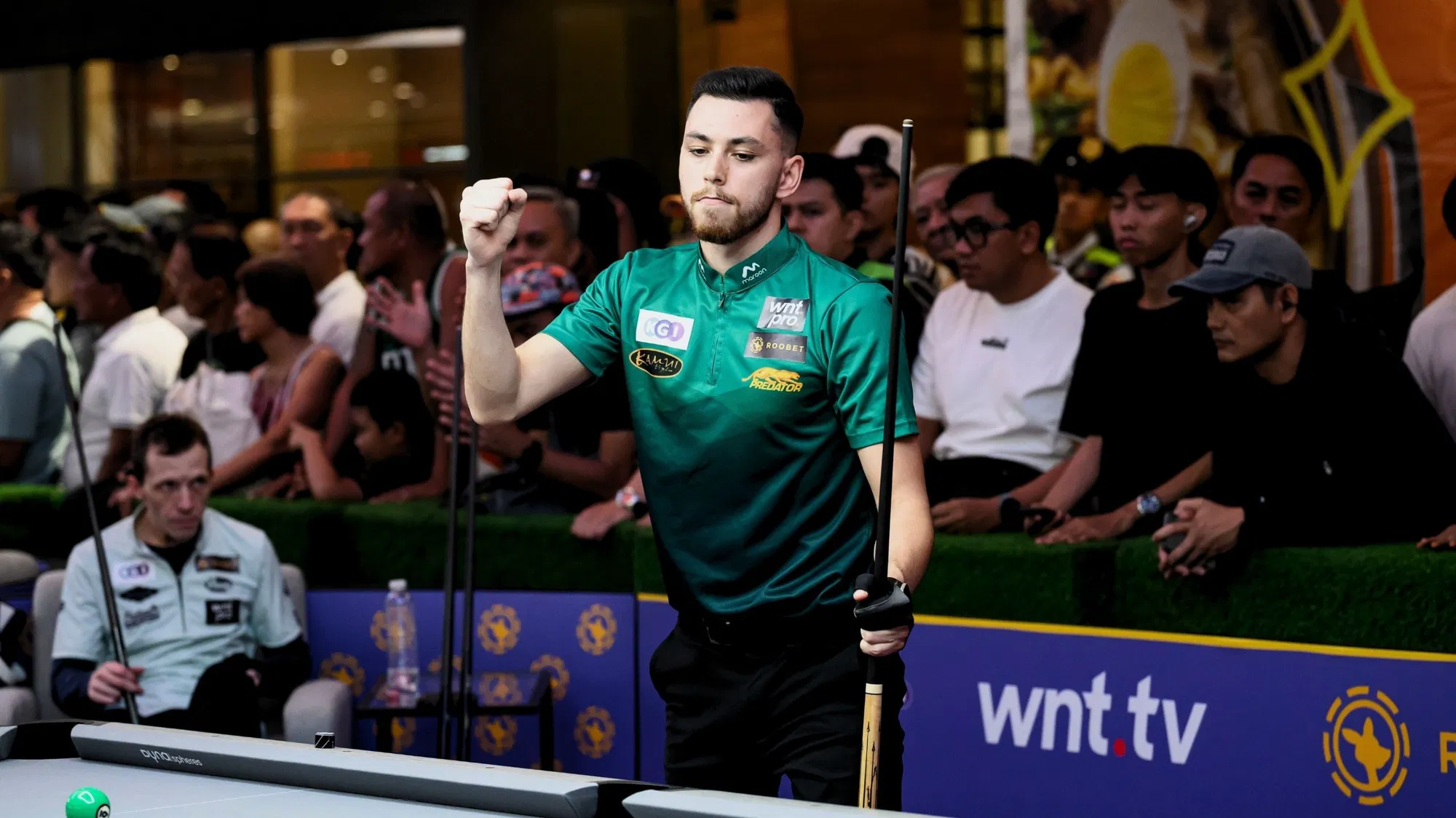
Rest of World Seizes 6-3 Reyes Cup Lead on Day Two
Filler, Gorst, Pecelj and Sanchez Ruiz drove a four-match haul as the visitors changed the balance of the contest in Manila.
Team Rest of the World won four of five matches on Day Two of the 2026 Roobet Reyes Cup, turning a 2-2 tie into a 6-3 lead over defending champion Team Asia at Makati Coliseum.
The scoreboard shifted because Rest of the World kept finding answers after mistakes. Joshua Filler won in singles, Fedor Gorst and Aleksa Pecelj delivered in doubles, and Francisco Sanchez Ruiz joined Filler to survive a hill-hill finale. Carlo Biado stopped the session from becoming a sweep, but Asia now enters the second half of the event three points behind.
| Day Two match | Winner | Score | Overall score |
|---|---|---|---|
| Five-player team match | Rest of the World | 5-3 | ROW 3-2 |
| Filler vs Robbie Capito | Filler | 5-3 | ROW 4-2 |
| Gorst/Pecelj vs AJ Manas/Duong Quoc Hoang | Gorst/Pecelj | 5-3 | ROW 5-2 |
| Biado vs Shane Van Boening | Biado | 5-3 | ROW 5-3 |
| Sanchez Ruiz/Filler vs Capito/Albert Januarta | Sanchez Ruiz/Filler | 5-4 | ROW 6-3 |
Where did Day Two begin to turn against Team Asia?
Asia had the start it wanted in the opening team match. AJ Manas won the lag, Duong Quoc Hoang helped secure the first rack, and a golden break from Duong pushed the home side toward a 3-1 advantage.
Then the session changed direction.
Robbie Capito missed his target with a jump shot, allowing Aleksa Pecelj back to the table. Fedor Gorst followed with a sharp 3-9 combination after a Manas foul, bringing Rest of the World level at 3-3. Sanchez Ruiz took the next rack before Duong scratched, and Filler finished the 5-3 comeback with a 6-9 combination.
That point did more than move the overall score to 3-2. It gave Rest of the World its first lead of the week after trailing 2-0 on the opening night. Asia had created a two-rack cushion and still watched it disappear, a warning that early control would not be enough against this lineup.
Why was Joshua Filler the central figure in the surge?
Filler appeared in three of Rest of the World's four wins: the team match, his singles contest with Capito, and the closing doubles match alongside Sanchez Ruiz. His value came from resetting quickly when a rack became messy.
The singles match was a good example. Both players made early errors. Capito missed the 7-ball, Filler scratched, and the German later failed to pocket the 9-ball on a two-way attempt. Capito then scratched on a cut, leaving ball-in-hand and a 2-1 lead for Filler.
Once ahead, Filler raised the pace. A break-and-run made it 3-1, and another fast clearance carried him to the hill. Capito stayed alive with an excellent jump escape, but Filler answered with a demanding safety and closed the table for a 5-3 win.
There was no perfect performance here. That was the point. Filler did not need every part of his game to be settled before he started influencing the score. He absorbed the mistakes, stayed aggressive and converted the later chances that mattered.
How did Gorst and Pecelj put Asia under deeper pressure?
Gorst and Pecelj gave Rest of the World a third consecutive point by beating Manas and Duong 5-3. Their partnership looked especially calm after an opening exchange of break-and-runs.
Duong's miss on a routine 8-ball opened the match. A scratch from Manas on the next break helped the Rest of the World pair stretch the advantage to 4-1.
Asia fought back. Manas and Duong won two racks in a row, with the second arriving after a rare error from Gorst on the 2-ball. The room had reason to believe another comeback was developing.
Instead, the deciding break produced a brutal reversal. Manas pocketed the 9-ball but scratched on the same shot. The golden break Asia needed became a loss of rack and match.
At 5-2 overall, Rest of the World had created its largest lead in Reyes Cup history. More important, three different combinations had contributed. This was no longer a response built around one hot player.
What did Carlo Biado's comeback save for Team Asia?
Biado faced Shane Van Boening with Asia in danger of losing every match in the session. He fell behind 3-1 after a foul in the fourth rack, leaving the defending champion close to a four-point overall deficit.
The Filipino changed the rhythm through safety play. He slowed Van Boening, won two straight racks to reach 3-3, then received a major opening when the American scratched on the break. Biado moved to the hill and completed the comeback 5-3.
It was Asia's only point of the day, but it was not a minor consolation. A sweep would have sent Rest of the World into a 7-2 lead. Biado kept the gap at two before the final doubles match and gave his younger teammates proof that the session could still be interrupted.
His role is growing as the pressure rises. Manas, Capito and Januarta are all facing different levels of expectation in front of the Manila crowd. Biado has already won a world title and understands what a short race feels like when one mistake can change the entire room.
How did the final doubles match expose the new balance of power?
Capito and Albert Januarta had a chance to cut the deficit to one. They led Sanchez Ruiz and Filler 2-0, later recovered from three lost racks, and reached the hill first at 4-3 after an 8-9 combination.
Rest of the World still found a way through. A failed snooker from Capito allowed the European pair to force a deciding rack. Sanchez Ruiz then fouled on the 1-ball, seemingly handing Asia the decisive opening.
The table refused to cooperate. Asia was left hooked, and Capito's jump attempt missed the object ball. Sanchez Ruiz and Filler cleared the remaining balls to win 5-4.
That final rack captured the difference between the teams on Day Two. Asia often reached a promising position, but Rest of the World stayed close enough to punish the next error. Filler and Sanchez Ruiz did not dominate the match. They survived it, and survival was worth exactly the same point.
What must Team Asia change while trailing 6-3?
The Reyes Cup is a race to 11, so Rest of the World needs five more points while Asia needs eight. The arithmetic puts urgency on the defending champion, but the larger problem is how often leads slipped away.
Asia led 3-1 in the team match and 2-0 in the closing doubles. Manas and Duong also threatened a late recovery after falling 4-1 behind. Each time, a scratch, missed jump or positional error gave the table back.
Rest of the World has now won six of the last seven matches after losing the first two on Day One. Captain Ralf Souquet can also point to contributions across his roster: Filler, Sanchez Ruiz, Gorst, Pecelj and Van Boening have all been involved in winning points.
Asia is not out of the contest. Biado's singles recovery prevented the worst possible score, and every remaining match is still a short race to five. But the defending champion can no longer rely on the weight of its two previous Reyes Cup titles. For the first time in the event's three-year history, Rest of the World carries the lead into the closing stages.
What is the score after Day Two of the 2026 Reyes Cup?
Team Rest of the World leads Team Asia 6-3 after winning four of the five matches in the second session.
Who won the only Day Two point for Team Asia?
Carlo Biado came back from 3-1 down to beat Shane Van Boening 5-3.
How many Day Two matches did Joshua Filler help win?
Filler contributed to three wins: the team match, a 5-3 singles victory over Robbie Capito, and a 5-4 doubles win with Francisco Sanchez Ruiz.
How many points are needed to win the Reyes Cup?
The first team to reach 11 points wins the event. Rest of the World needs five more points, while Team Asia needs eight.