TournamentsWorld Championships
2026 WPA Men's 10-Ball World Championship: Field, Format and Payouts
A 96-player field competes for $300,000 in Ho Chi Minh City under a set-based format that shifts from double to single elimination.
The 2026 Iwan Simonis WPA Men's 10-Ball World Championship brings 96 players to Ho Chi Minh City from September 19-26 for a $300,000 title race built around set play, double elimination and a decisive 32-player knockout stage. The champion will earn $80,000 at Phu Tho Indoor Stadium, while half of the starting field will reach the payout positions.
What are the key facts about the 2026 World 10-Ball Championship?
The championship is the men's 10-ball centerpiece of the 2026 Pro Billiard Series stop in Vietnam. Its official event page lists a 96-player field, a $500 entry fee and a $300,000 total prize fund.
| Tournament detail | Official information |
|---|---|
| Dates | September 19-26, 2026 |
| Host city | Ho Chi Minh City, Vietnam |
| Venue | Phu Tho Indoor Stadium |
| Field | 96 players |
| Discipline | 10-ball |
| Entry fee | $500 |
| Total prize fund | $300,000 |
| Champion's prize | $80,000 |
| Paid positions | 48 |
The venue is located at No. 1 Lu Gia Street in Ho Chi Minh City. The eight-day window gives the tournament enough time to move through two distinct phases without abandoning the set-based format used throughout the event.
How does the double-elimination stage work?
The opening phase uses double elimination until 32 players remain. A player is therefore not removed from the championship after a first defeat; elimination follows a second loss during this phase.
Each double-elimination match is best of three sets. Every set is a race to four racks, so the first player to win two sets advances on the winners' side or remains alive on the one-loss side.
This structure separates match victory from a single long rack race. A player can lose one short set, adjust and still win the match by taking the other two. It also creates repeated pressure points because every set resets the score.
What changes when the field reaches the last 32?
The surviving 32 players enter a single-elimination bracket. From that point, one match defeat ends a player's championship run.
Knockout matches expand to best of five sets, with each set still played as a race to four. A player must win three sets to advance. The longer match format gives the later rounds more room to test breaking consistency, tactical control and the ability to recover between sets.
If the deciding set reaches 3-3, the official format calls for a shootout to determine the winner. That rule prevents a deciding set from continuing indefinitely and creates a clearly defined final test in the closest matches.
How is the $300,000 prize fund distributed?
The payout schedule rewards the top 48 finishers, exactly half of the 96-player field. The champion receives $80,000, which is more than one quarter of the full prize fund.
| Finish | Prize per player | Number of players | Total paid at level |
|---|---|---|---|
| Champion | $80,000 | 1 | $80,000 |
| Runner-up | $40,000 | 1 | $40,000 |
| 3rd-4th | $20,000 | 2 | $40,000 |
| 5th-8th | $10,000 | 4 | $40,000 |
| 9th-16th | $5,000 | 8 | $40,000 |
| 17th-32nd | $2,500 | 16 | $40,000 |
| 33rd-48th | $1,250 | 16 | $20,000 |
The table adds up to the advertised $300,000. Reaching the final 48 guarantees $1,250, while entering the last 32 doubles that amount to $2,500. Every further completed stage from the last 16 through the runner-up position is worth at least twice the previous payout.
Which players headline the 96-player field?
The published field combines current international contenders with established champions and experienced tour players. Fedor Gorst, Francisco Sanchez-Ruiz, Shane Van Boening, Joshua Filler and Jayson Shaw are among the most recognizable names on the entry list.
The field also includes Carlo Biado, Aloysius Yapp, Johann Chua, Eklent Kaci, Albin Ouschan, Alex Kazakis, Wiktor Zielinski, Skyler Woodward, Mario He, Pijus Labutis and Moritz Neuhausen.
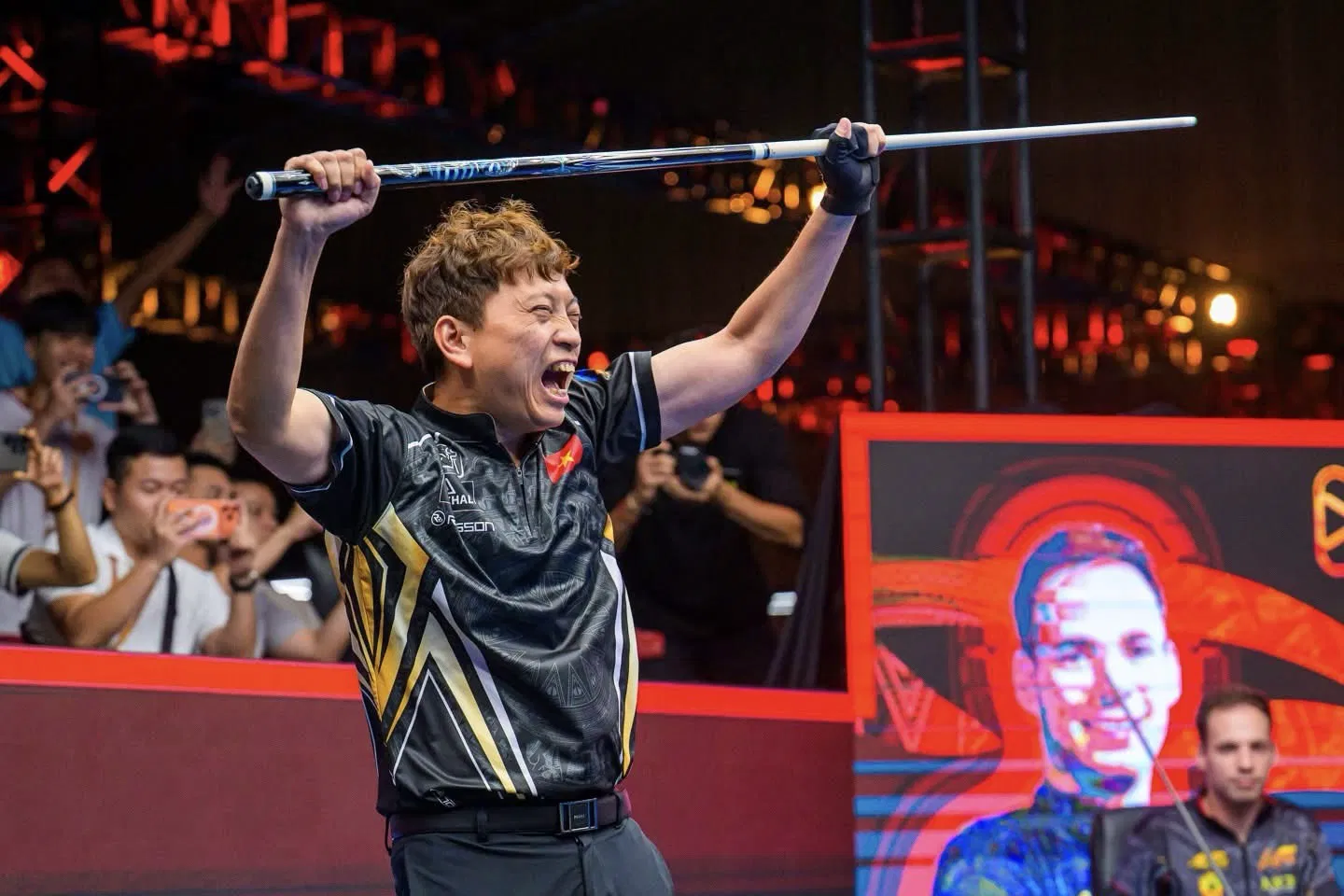
Several highly experienced players add another layer to the draw, including Alex Pagulayan, Darren Appleton, Niels Feijen, Ralf Souquet and Thorsten Hohmann. Vietnam is represented by a group that includes Duong Quoc Hoang, Chu Viet Hoang, Luong Duc Thien, Nguyen Anh Tuan, Le Mi and Phuong Nam Pham.
The variety matters under the championship format. Short races inside a set can reward fast starts, but the multi-set match structure gives experienced players opportunities to adjust. The double-elimination phase also offers one route back after an early defeat, while the last 32 removes that safety net.
Why is the transition at 32 players important?
The tournament's most important structural threshold is not the quarterfinal or semifinal. It is the move from 33 players to 32.
That transition changes both competitive risk and guaranteed earnings. A player finishing 33rd-48th leaves with $1,250. A player who reaches the final 32 secures at least $2,500 and enters the single-elimination bracket, where every victory doubles the next guaranteed payout through the last 16, quarterfinals and semifinals.
From a competition perspective, the early phase tests recovery over two-loss conditions. The knockout phase tests immediate execution. A player who survives the one-loss side can still win the world title, but there is no second chance after the field is reduced to 32.
What should fans track as the tournament develops?
The first major data point is which seeded contenders stay on the winners' side through the double-elimination phase. Remaining unbeaten reduces the number of survival matches a player must contest and can produce a cleaner route into the final 32.
The second is set conversion. Because matches are divided into races to four, rack totals alone do not explain the result. A player can win more racks overall and still lose if those racks are distributed across the wrong sets.
The third is performance in deciding-set shootouts. Any best-of-three or best-of-five match can reach a final set, and a 3-3 score in that set moves the result to the tournament's shootout procedure. Those moments can decide who enters the money, who advances through the knockout bracket and ultimately who plays for the $80,000 first prize.
When is the 2026 WPA Men's 10-Ball World Championship?
The tournament runs from September 19 through September 26, 2026.
Where is the championship being played?
It is being held at Phu Tho Indoor Stadium, No. 1 Lu Gia Street, Ho Chi Minh City, Vietnam.
How many players are in the field?
The official field contains 96 players.
What is the total prize fund?
The tournament has a $300,000 prize fund, with $80,000 awarded to the champion.
What is the playing format?
The event uses double elimination to the last 32, with best-of-three-set matches. The final 32 switch to single elimination and best-of-five-set matches. Every set is a race to four, and a shootout decides a match when the deciding set reaches 3-3.