Petroni and Correia Win First 2026 European Seniors Golds
A one-point escape for Petroni and another milestone for Correia delivered two sharply contrasting championship stories in Spain.
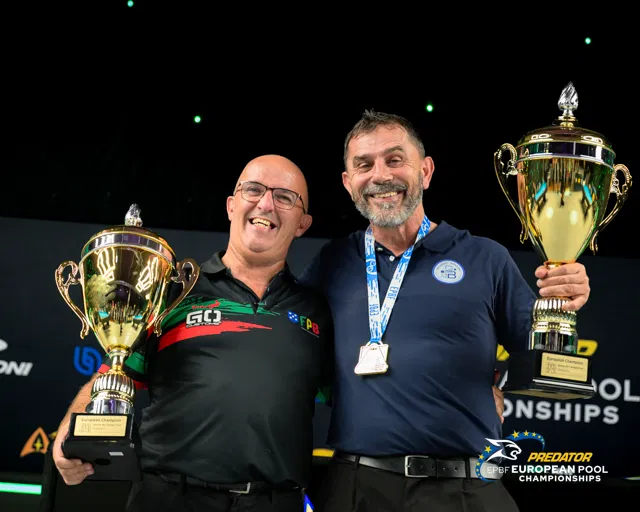
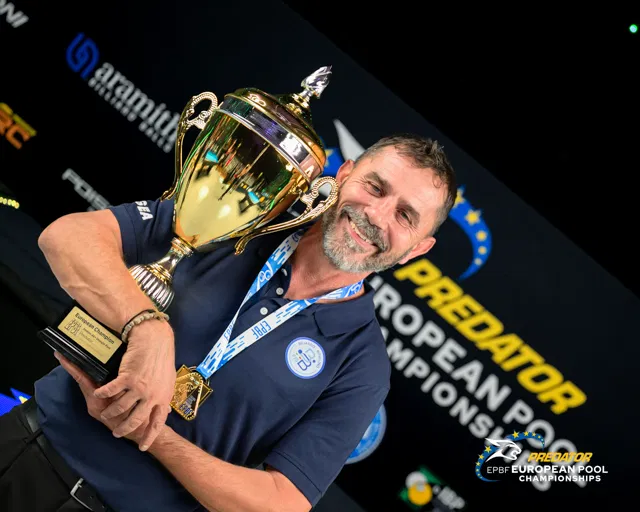
Fabio Petroni completed a 45-point comeback to win the 46-plus straight pool title by a single point, while Henrique Correia captured his 20th European Seniors gold in the 56-plus division at the 2026 championships in Spain.
Petroni trailed Jim Telfer 74-29 before recovering for a 75-74 victory. Correia followed a different route against Reiner Wirsbitzki, using a 44-ball run to seize control before closing a 75-50 win. Together, the two finals delivered contrasting opening champions: one escaped from the edge of defeat, while the other added another title to one of the strongest records in European senior pool.
| Division | Champion | Runner-up | Final score |
|---|---|---|---|
| 46-plus straight pool | Fabio Petroni, Italy | Jim Telfer, Netherlands | 75-74 |
| 56-plus straight pool | Henrique Correia, Portugal | Reiner Wirsbitzki, Germany | 75-50 |
How did Fabio Petroni recover from 74-29 down?
Telfer needed only one more point. Petroni needed 46.
The Netherlands representative, a Scot now competing under his adopted country, had built a 74-29 advantage and received two difficult chances to finish the final. Neither produced the winning ball.
Petroni finally gained control and used a favorable break position to run through the table. The comeback was not completed in one perfectly ordered sequence. His final break ball left a more awkward position, and he had to manage the closing points without the open layout he wanted.
At 74-74, Petroni attempted a two-way shot. The object ball did not fall, but the cue ball finished safe and left Telfer with no easy route. Telfer tried to free the 1-ball from a cluster and send it toward the side pocket. The attempt fell short and left an open ball.
Petroni made it.
The 75-74 score hides how improbable the recovery was. Petroni did not simply win the last rack of a close race. He watched his opponent move within one point of gold, then constructed almost an entire short match while one mistake could end the final.
Why was the final point more tactical than spectacular?
Straight pool rewards long runs, but the championship ball came from safety pressure.
Petroni's two-way attempt at 74-74 was designed to offer more than one acceptable outcome. Potting the ball would have ended the final immediately. Missing while leaving Telfer safe protected the Italian from handing over a simple winner.
That second outcome became decisive. Telfer had to attack from a poor position because waiting carried its own risk. His attempt to move the 1-ball through traffic did not succeed, and Petroni returned to a table with the championship ball available.
The sequence captured the mental burden of a one-point finish. Telfer had been in control for most of the match, but every decision after reaching 74 carried the weight of being his last. Petroni, having already accepted that defeat looked likely, could play the closing sequence with fewer expectations.
Petroni admitted afterward that he had believed the match was lost. He credited some favorable rolls, but luck alone did not produce 46 points under elimination pressure. He still had to recognize patterns, control the break ball and choose the safety that created the final chance.
The victory also changed his confidence for the remaining disciplines. Petroni said he had struggled the previous day before finding stronger form in the final session. A player who wins after being one point from defeat leaves with a different sense of possibility.
How did Henrique Correia take control of the 56-plus final?
Correia's final against Wirsbitzki began with the German making the first major move. A 27-ball run gave Wirsbitzki the early initiative and confirmed the quality that had made him one of the leading straight pool players at the championships.
Correia answered with 44.
The Portuguese veteran's run carried him to a 54-29 lead and changed the shape of the match. Wirsbitzki still had a response, scoring 21 points to reduce the gap to four.
He did not score again.
Correia pocketed the final 21 points and completed a 75-50 victory. Unlike Petroni's final, the deciding stretch did not depend on a last-ball error by the opponent. Correia absorbed the comeback attempt and then closed the remaining distance himself.
His final shot required commitment. Correia described going all-in on an aggressive finish, trusting the shot rather than extending the safety exchange. The ball dropped, and another European title joined a collection that has become exceptional even by senior championship standards.
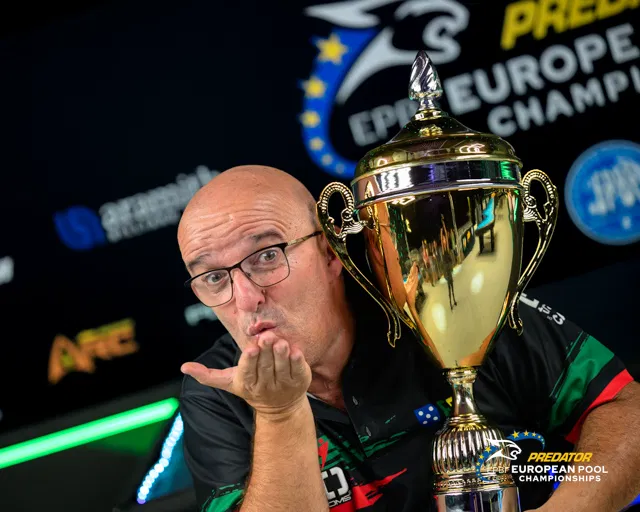
What does a 20th European Seniors gold mean for Correia?
Correia now counts 15 individual European Seniors gold medals and five team titles. The 56-plus straight pool victory brought the total to 20.
The number matters because it measures more than one period of dominance. Senior championships require players to retain technique, concentration and competitive appetite across multiple years and age categories. Correia has continued winning while the field and formats around him have changed.
He treated the latest title as proof that he can still perform at the top. That reaction explains why the medal did not feel routine despite the size of his collection. Each new championship answers the same question again: can the player reproduce his standard under current conditions against today's strongest opponents?
Wirsbitzki made that question difficult. Correia described the German as the best straight pool player across the two senior divisions at the event. The final result did not diminish Wirsbitzki's reputation; it showed that even the most reliable scorer can be overtaken when an opponent produces a 44-ball run at the right moment.
Correia also connected the victory to Portugal, his city, family, friends and sponsors. His motivation is no longer limited to adding another medal for himself. The title carries the people and institutions he represents each time he enters the arena.
What separated the two championship performances?
Petroni and Correia both reached 75, but their victories asked for different qualities.
Petroni needed emotional recovery. At 74-29, the scoreboard offered almost no realistic margin. He had to stop thinking about the deficit and treat each available ball as the only problem in front of him.
Correia needed control after resistance. His 44-ball run established the lead, but Wirsbitzki cut the margin to four. Correia then had to prevent the match from becoming a late exchange and finish the last 21 points.
Petroni won through survival, pattern play and one precise safety at 74-74. Correia won through two decisive scoring bursts separated by a German response.
The finals also illustrate why straight pool produces unusual pressure. In rotation games, players often reset after each rack. In 14.1, one visit can continue across multiple racks and erase a lead that looked secure minutes earlier. Telfer's 45-point advantage disappeared because Petroni finally gained a long turn at the table. Wirsbitzki's early run was answered by an even larger one.
Both champions had to believe that control could change immediately.
Who else reached the opening medal rounds?
Telfer earned silver after coming within one ball of the 46-plus title. His final will be remembered for the lead that disappeared, but reaching 74 first reflected how well he had played before the closing sequence.
Wirsbitzki collected silver in the 56-plus division. His runs of 27 and 21 demonstrated why Correia regarded him so highly, even though the German could not score after cutting the deficit to four.
Francisco Rafael Barcelo of Spain and Roger Lysholm of Norway received bronze medals in the opening championship action.
The medal results also set the tone for a nine-day event. Correia returns quickly to defend his 10-ball title, while the women's divisions enter the program. The championships continue through October 27, when the three 9-ball competitions and two team events conclude.
That schedule rewards players who can reset after success or disappointment. Petroni and Correia have their first golds, but both must move from celebration back to preparation if they want to add more.
Where can fans follow the European Seniors Championships?
Tables 1, 2 and 3 are streamed through the Pro Billiard TV channel on YouTube. The European Pocket Billiard Federation provides the complete draws, results and live scoring through its official championship pages.
After the seniors event ends on October 27, the final Predator Euro Tour tournament of the season begins in Spain. The Revora Spanish Open runs from October 29 through November 1.
Who won the opening 2026 European Seniors gold medals?
Fabio Petroni won the 46-plus straight pool title, while Henrique Correia captured gold in the 56-plus division.
What was the score in Petroni's final?
Petroni came back from 74-29 down to beat Jim Telfer 75-74.
How did Correia defeat Reiner Wirsbitzki?
Correia produced a 44-ball run to take control and scored the final 21 points for a 75-50 victory.
How many European Seniors gold medals has Correia won?
Correia has won 20 gold medals in total: 15 individual titles and five team championships.
Where can the championships be watched?
Fans can watch streamed tables through Pro Billiard TV on YouTube and follow live results through the EPBF website.